
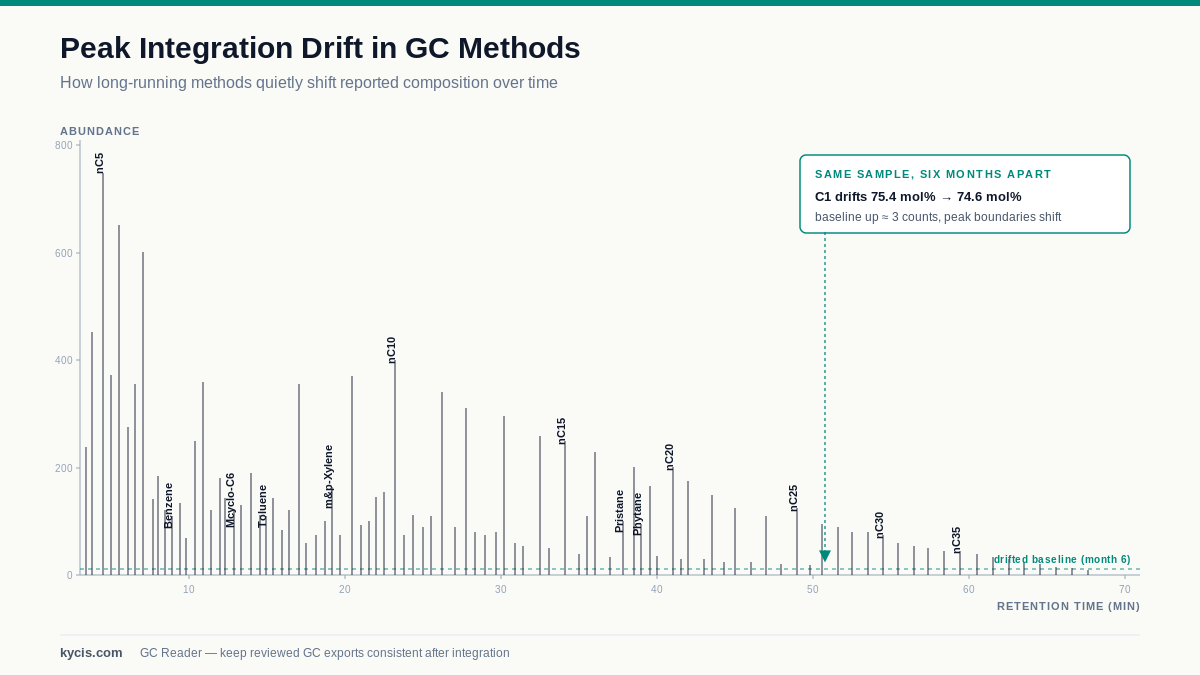
Peak integration drift is one of the quieter ways GC composition results move over time. The chromatogram may still look acceptable, and the method may still export a valid CSV, but small changes in baseline treatment, integration thresholds, retention windows, or manual review habits can alter reported peak areas enough to affect final composition values.
A method that worked well for months can suddenly report 0.8 mol% less C1 or 1.2 mol% more C7+ even though the chromatogram still “looks fine.”
This article is about recognizing and controlling inconsistent integration as a PVT lab workflow issue. It is not an instrument-repair guide, and it does not replace chromatographer review. The point is to separate two responsibilities: chromatography review happens first; once the lab accepts the export, downstream composition processing also needs to remain repeatable and auditable.
What Peak Integration Drift Means
Peak integration converts chromatogram signal into peak area, amount, or reported component value. For a PVT lab, those values may later feed gas composition, liquid composition, FID/TCD merge, internal-standard normalization, air correction, recombination, and client reporting. When integration drifts, comparable samples no longer receive comparable peak boundaries or baseline treatment.
The shift can come from several places: baseline changes, column aging, detector response changes, method edits, report-template changes, retention-window updates, or gradual changes in manual reintegration habits. A software export can still be structurally valid while carrying a different analytical basis from the one used earlier in the project.
A CSV export can be perfectly readable and still carry inconsistent analytical assumptions. That is why integration review belongs upstream of any automated composition workflow. Chromatography integration practices are governed by the lab’s validated methods, review procedures, and applicable analytical guidance. Downstream processing should not pretend to decide whether the chromatogram was integrated correctly.
Why Long-Running Methods Are Vulnerable
PVT labs often run similar gas and liquid sample types for months or years. That stability is useful, but it also creates exposure. A method may start with reviewed integration events and reporting settings, then accumulate small changes as sample types, maintenance events, operators, and client formats are added.
Retention windows may be adjusted after a column replacement. Event tables may be edited after a baseline problem. A report template may be changed for one project. Detector tuning, carrier-gas conditions, column aging, software updates, and ChemStation revisions can all change how the same sample type is integrated or exported. Staff changes matter too: two chromatographers can follow the same method and still develop different habits around manual integration, baseline assignment, or marginal peak boundaries.
The lab may not notice the reported-value movement until a client questions a composition trend, a duplicate run does not match, a reference gas check starts to move, or downstream engineering results look inconsistent.
Common Symptoms in Composition Results
Integration drift usually appears first as a pattern, not as a single obvious failure. Light components may shift while the total still normalizes to 100%. Crossover components near the FID/TCD merge boundary may become unstable. C6+, C7+, or C10+ lump values may move without a clear sample explanation. Duplicate or repeat runs may show inconsistent component ratios. Liquid GC results corrected by internal standard may become less repeatable. Unknown or unexpected component labels may appear after a method or report-template change.
Normalization can hide the problem. A composition can sum to 100 mol% and still be wrong if the underlying peak areas were assigned inconsistently. A normalized trend can still reflect integration behavior rather than reservoir behavior.
Not every variation between duplicates is drift. Methods have normal repeatability tolerances, and small day-to-day differences are expected. The harder pattern is a directional shift over weeks or months, a change that correlates with a method edit or instrument event, or a systematic operator difference.
For example, a C1 value that slowly moves from 78.2 mol% to 77.1 mol% over three months, while duplicate repeatability remains within +/-0.3 mol%, is a stronger warning sign than one isolated failed duplicate. The pattern points to unstable integration basis or baseline treatment before it points to actual reservoir change.
Baseline Drift vs. Integration Parameter Drift
Baseline drift and integration parameter drift are related, but they are not the same problem. Baseline drift refers to a change in the signal background across a run or over time. It can be caused by instrument condition, column behavior, carrier-gas issues, detector response, contamination, or maintenance state. If the baseline moves, the area assigned to a peak can change even when the method settings have not been intentionally edited.
Integration parameter drift is a data-processing consistency problem. Thresholds, skim rules, tangent events, retention windows, integration events, report settings, and manual edits can change how peak areas are assigned. These changes may be legitimate and documented, or gradual and informal. Either way, they can alter exported peak areas.
The lab should distinguish an instrument condition problem from a data-processing consistency problem. If the baseline is unstable, the corrective path may involve maintenance, troubleshooting, or recalibration. If integration parameters or manual review habits have changed, the corrective path may involve method review, documented reintegration, or revalidation. Both belong on the chromatography side of the workflow.
Why FID/TCD Merge Makes Drift More Visible
Dual-detector gas methods make integration drift more visible because the final composition depends on consistent detector-side values. The thermal conductivity detector and flame ionization detector may cover different component ranges, and the merge workflow must decide which value to use, how to handle overlap, and how to normalize the combined composition.
Components near the crossover or scaling point are especially sensitive. If integration drift changes a reference component, a neighboring peak, or a detector-side value used in the merge, the combined gas composition may shift even when the merge spreadsheet or software rule has not changed. In other words, the downstream merge calculation can be stable while the accepted inputs feeding it have moved.
This is why merge review and integration review should be connected in the lab’s QC thinking. A duplicate that looks acceptable on one detector side may still expose instability after the FID/TCD merge. Drift near the merge boundary can be amplified because one unstable reference or crossover value influences the combined gas composition. For more on the calculation side, see FID/TCD merge in gas chromatography.
Why Liquid GC and Internal Standard Workflows Need Extra Care
Liquid GC workflows often depend on an internal standard. That makes integration consistency important not only for the sample peaks, but also for the internal-standard peak and any nearby peaks that may affect its boundary or baseline. If the internal standard is integrated inconsistently, corrected values can shift even when the sample composition itself has not changed.
Internal-standard correction is useful, but it has a clear limit. It can help compensate for broad response or injection-volume variation across the liquid run. It cannot fully correct peak integration drift caused by inconsistent peak boundaries, baseline assignment, event timing, or manual reintegration. If the accepted peak areas are not comparable, ISD normalization may make the table look more orderly while still carrying the integration inconsistency forward.
Integration drift can therefore appear downstream as normalization drift. The analyst sees corrected liquid results that are less repeatable, but the underlying issue may be the accepted integration basis around the internal standard, a neighboring component, or a heavy-end region. Because liquid-side values may later feed recombination, a small integration inconsistency can become more visible in the final composition.
The calculation workflow still needs to preserve internal-standard settings after export. But the decision that the internal-standard peak was integrated correctly remains a chromatographer responsibility. For calculation context, see ISD normalization in gas chromatography.
What Should Be Reviewed Before Export
Most labs already run reference gases, duplicate samples, or periodic QC checks to catch drift. Those practices remain the primary line of defense. The checklist below is the export-side review that still needs to happen even after QC samples have cleared.
- Confirm peak identification for key components. The expected components should be identified correctly, especially light gases, crossover components, internal standards, and heavy-end lumps.
- Review baseline placement around critical peaks. Watch for slow baseline changes, inconsistent valley-to-valley choices, or peak shoulders that are treated differently between runs.
- Check retention-time shifts against method windows. Small shifts may be acceptable, but they should not assign components to the wrong window or event.
- Confirm integration events and manual integrations are consistent. Manual integration may be necessary, but it should be documented and applied according to the lab’s procedure.
- Compare duplicate, reference, or QC sample ratios. Absolute totals may normalize cleanly, so component ratios and detector-side patterns are often more revealing.
- Verify detector sections and component names are still exported as expected. A report-template change can alter sections, labels, or row order even when the chromatogram review is acceptable.
- Note whether method, calibration, maintenance, or report-template changes occurred. A drift pattern is easier to understand when the lab can connect it to a documented event.
GC Reader can help after export, but the lab still needs to accept the chromatogram and integration before treating the CSV as a valid input. If the export procedure itself needs tightening, this guide on how to export Agilent ChemStation data for PVT lab use covers the handoff from ChemStation into downstream processing.
When drift is detected, the corrective action sits on the chromatography side: recalibration, documented manual reintegration, method revalidation, or column/detector maintenance. Once those decisions are accepted, downstream processing should pick up the corrected export consistently without rebuilding spreadsheet logic each time.
What Should Be Controlled After Export
Once the lab accepts the export, downstream processing should not add another layer of uncontrolled variation. This is where many PVT workflows become fragile: the accepted CSV is copied into a spreadsheet, sorted by hand, corrected in one workbook, normalized in another, and recombined later by someone else.
After export, component aliases should be explicit. Unknown names should be flagged for review instead of silently ignored. FID/TCD merge rules should be applied the same way from sample to sample. Air correction should be visible, with corrected values and assumptions traceable. Internal-standard normalization parameters should be preserved. GOR recombination should record the gas and liquid pairing, GOR value, and final basis.
The final output should also show review flags, notes, and deliverable format clearly enough that a lab manager or reservoir-fluid consultant can trace the result. That does not prove the original integration was correct. It proves that the accepted export was processed consistently after signoff.
This distinction matters. Downstream controls can expose inconsistencies after export through unknown-name flagging, explicit alias review, repeated processing with the same rules, and comparable output structure. That is not the same as detecting or fixing bad chromatographic integration. For the broader export-to-composition workflow, see from ChemStation CSV to engineering-ready composition. For a common gas-side correction, see air correction in GC analysis.
Where GC Reader Fits
Decisions about peak boundaries, manual integration, baseline assignment, method updates, and calibration remain chromatographer responsibilities. GC Reader’s role starts only after those decisions are signed off.
Once the lab has accepted the integration, GC Reader helps ensure that the same accepted export is processed with the same alias rules, merge logic, correction parameters, normalization settings, and recombination basis every time. That reduces one major source of downstream variation without replacing chromatographer review.
In practice, GC Reader reads ChemStation CSV exports, flags unknown component names for alias review, applies consistent FID/TCD merge logic, supports air correction and internal-standard normalization, and preserves a repeatable export-to-composition workflow. For workflows that later involve recombination, it can also keep the basis explicit once the reviewed results are ready to combine.
The goal is not to claim that software downstream of ChemStation can repair integration drift. It cannot. The goal is to prevent accepted GC exports from being transformed inconsistently after review, especially across recurring reports, operators, and projects.
Auditability Matters When Results Are Questioned
Peak integration drift becomes expensive when a result has already reached a client report, EOS model, or reservoir-fluid interpretation. At that point, the lab needs to answer practical questions: which chromatogram was reviewed, which method version was used, whether manual integration was applied, and how the accepted CSV became the final composition.
Auditability does not remove the need for chromatographer judgment. It makes that judgment easier to defend and separates analytical questions from downstream processing questions. If the chromatogram and integration need review, the lab can focus upstream. If the accepted export was transformed inconsistently after review, the lab can focus on aliases, merge logic, correction parameters, normalization settings, recombination basis, and report formatting.
GC Reader workflow
Keep reviewed GC exports consistent after integration
If your lab already reviews chromatograms in ChemStation but still spends time rebuilding spreadsheets for detector merge, aliases, correction, normalization, or recombination, send us a representative export. We can review whether GC Reader fits your export-to-composition workflow. Labs that want hands-on evaluation can also request a 14-day trial.
Send a sample ChemStation export Email KYCIS Review GC Reader
References
- Agilent OpenLab CDS documentation describes manual integration actions such as changing peak start, peak end, and peak baseline. Access the Agilent manual integration documentation.
- ASTM D1945 covers natural gas and similar gaseous mixture analysis by gas chromatography, including composition data used for physical-property calculations. Access the ASTM D1945 standard page.