
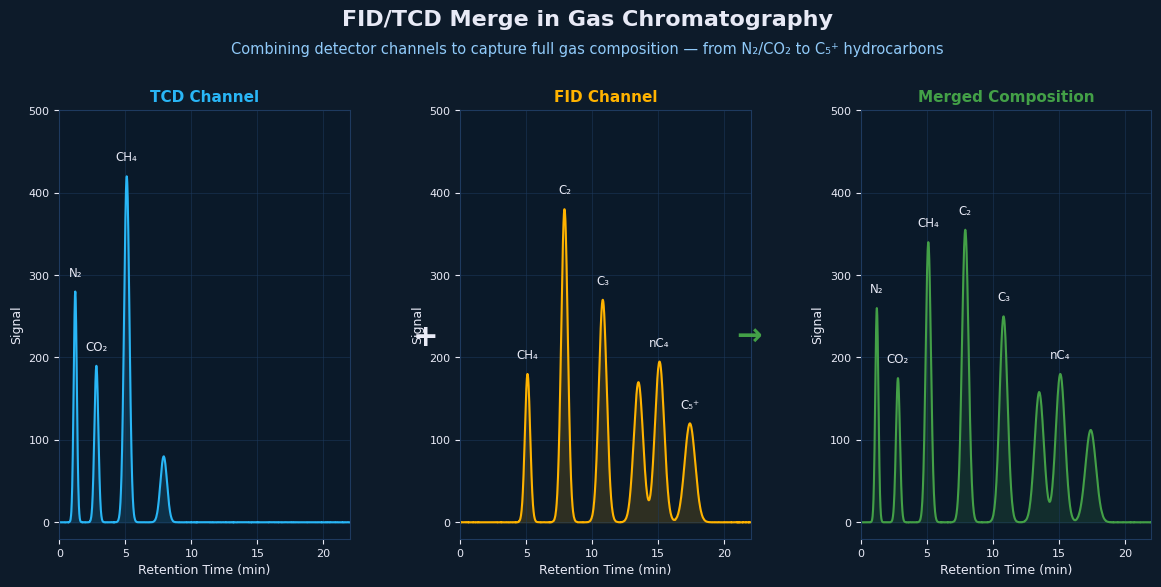
Most PVT labs run dual-detector gas chromatographs — a Thermal Conductivity Detector (TCD) for permanent gases and light components, paired with a Flame Ionization Detector (FID) for heavier hydrocarbons. The separation of duties makes sense: TCD responds well to nitrogen, carbon dioxide, and hydrogen sulfide that FID misses, while FID provides better sensitivity and linearity for C₃ through C₇₊.
The problem comes at the merge step. When your GC finishes a run, you have two separate composition tables — one from each detector. Combining them into a single, normalized wellstream composition sounds straightforward, but done incorrectly it produces composition errors that propagate silently through every PVT calculation you run afterward.
Why Two Detectors Are Needed
TCD (Thermal Conductivity Detector)
TCD operates by comparing the thermal conductivities of two gas streams: pure carrier gas (the reference) and carrier gas plus sample components (the column effluent). A heated tungsten-rhenium filament is maintained at constant temperature; as sample components pass over it, the power required to hold that temperature changes. In the Agilent 7890, the two gas streams alternate across the filament five times per second — this switching produces the characteristic ticking sound you hear when the detector is running.
Crucially, TCD is a non-destructive detector. It doesn’t consume the sample during detection. This is the physical reason dual-detector GC systems work: TCD is connected in series before the FID, so the same column effluent passes through TCD first, is measured, and then continues to the FID for a second measurement.
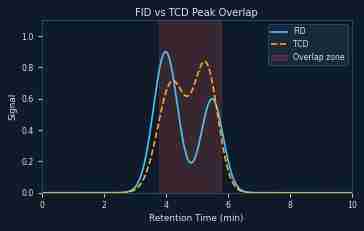
TCD responds to virtually everything — hydrocarbons, non-hydrocarbons, permanent gases. It’s the right tool for nitrogen (N₂), carbon dioxide (CO₂), hydrogen sulfide (H₂S), helium (when used as a tracer), and methane through ethane at high concentrations.
One practical note for sour gas analysis: the TCD filament is chemically passivated against oxygen damage, but H₂S and halogenated compounds can still attack it, causing a permanent change in detector sensitivity. Labs processing high-H₂S reservoir fluids should watch for baseline drift and factor filament condition into their calibration schedule.
TCD’s limitation is sensitivity and linearity at low concentrations. For heavier hydrocarbons at trace levels, the signal is too noisy to quantify reliably.
FID (Flame Ionization Detector)
FID passes sample and carrier gas through a hydrogen-air flame. The flame alone produces few ions, but burning an organic compound — any molecule with C-H bonds — significantly increases ionization. A polarizing voltage attracts the resulting ions to a collector near the flame; the current produced is proportional to the amount of sample being burned.
According to Agilent’s specifications for the 7890 series, the FID delivers sensitivity of 10 to 100 picograms of an organic compound (dependent on molecular structure) and a dynamic range of 1×10⁷. It has excellent sensitivity for hydrocarbons and very good linearity over a wide concentration range.
Its limitation is selectivity. FID has little or no response for compounds that don’t produce C-H bond ionization in the flame. This includes H₂O, CO₂, CO, N₂, O₂, CS₂, H₂S, and inert gases — none produce a usable FID signal. This is precisely why TCD is indispensable for complete reservoir fluid analysis.
The practical result: for a complete reservoir fluid composition, you need TCD for the non-hydrocarbons and FID for the heavier hydrocarbon fractions. Neither detector alone gives you the full picture.
Where the Merge Goes Wrong
Overlap Zone Mishandling
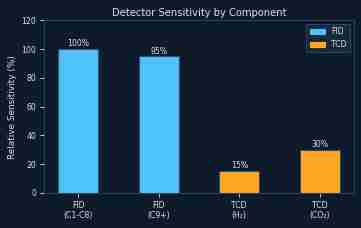
The overlap zone — typically methane through butane — is where both detectors produce valid signals. In the merge, you need to decide which detector’s result to use for each component in this range, or how to weight them.
The most common mistake is using FID values for methane and ethane when TCD values are more reliable for those components at high concentrations. FID response for methane is poor compared to heavier hydrocarbons (FID response factors scale roughly with carbon number), so at the concentrations typical of natural gas (40–90 mol% methane), the FID methane quantitation is less accurate than TCD.
Using the wrong detector for the wrong components introduces a systematic bias that shifts the entire normalized composition.
Normalization Sequence Errors
Both the FID and TCD tables are internally normalized to 100%. When you combine them, you cannot simply concatenate the two tables and re-normalize — the internal normalizations are already distorting the proportions relative to each other.
The correct approach is: identify a reference component that appears reliably on both detectors with good accuracy (often propane or n-butane in the overlap range), use the ratio of that component across both detectors to establish a scaling factor, and scale one detector’s results to match the other before combining and re-normalizing. Skipping this cross-calibration step is the single most common source of composition error in PVT labs that do manual merges.
Air Peak Contamination
Before merging, the air peak — nitrogen and oxygen from atmospheric contamination — needs to be separated from the actual nitrogen content of the sample. TCD will show a combined N₂ + O₂ peak (or two separate peaks if resolution is good enough). If both N₂ and O₂ are present in roughly a 79:21 ratio, that’s air contamination and needs to be subtracted out before normalization.
Ignoring this step leaves artificial nitrogen in the composition. In a gas with 3 mol% air contamination and 0.5 mol% true nitrogen, failing to correct inflates the nitrogen reading by 6× and depresses every other component’s normalized fraction.
The C₇₊ Lumping Problem
FID typically quantifies individual components through C₆ or C₇, then reports heavier material as a “C₇₊” lump. This lump requires a molecular weight and specific gravity assumption to characterize it for PVT purposes.
Where labs go wrong: using the default molecular weight and specific gravity embedded in the GC calibration (which may have been set years ago for a different fluid type) rather than measured values from a physical sample characterization. The C₇₊ fraction has an outsized impact on phase behavior calculations — a 10-unit error in the C₇₊ molecular weight can shift the calculated dewpoint by 5–15°C.
What a Correct Manual Merge Looks Like
A properly documented manual FID/TCD merge procedure: extract both detector tables from the ChemStation CSV; identify the crossover point (the heaviest component reliably quantified by TCD with good accuracy, usually C₂ or C₃); apply cross-calibration scaling using a reference component present in both tables; assign components to detectors (TCD → non-hydrocarbons + C₁; FID → C₂ or C₃ through C₇₊); remove air contamination from the TCD nitrogen/oxygen peaks; combine both tables into a single composition; normalize to 100 mol%; verify the sum and check individual components against expected ranges.
Done carefully in a spreadsheet, this takes 20–40 minutes per sample. With a batch of 10–15 samples from a single well test, that’s an afternoon of spreadsheet work that adds no engineering value.
Checking Your Results
After merging, sanity-check the composition against what you know about the fluid: Does the C₁/(C₁+C₂) ratio make sense for the reservoir pressure and temperature? Is the CO₂ content consistent with the field? Does the C₇₊ fraction match the expected liquid yield? Does the GOR implied by the composition match the separator test results?
Systematic errors in the merge — wrong detector assignment, missing cross-calibration — often show up as a composition that’s technically normalized to 100% but produces wildly incorrect phase behavior when run through a PVT simulator.
Automating the Merge
The merge logic is well-defined enough to automate completely. The inputs are fixed (ChemStation CSV files), the decision rules are consistent within a lab’s standard procedure, and the calculation steps are deterministic.
GC Reader was built specifically for this workflow. It reads Agilent ChemStation CSV exports, applies configurable FID/TCD merge logic, supports air correction, and outputs engineering-ready gas compositions without rebuilding the merge in a spreadsheet for every sample.