
A ChemStation CSV export is a starting point, not a finished engineering composition. It may contain detector output, component names, peak areas, sample identifiers, report-template headers, and method-specific formatting. But by itself, it is not yet a composition that can be handed to a PVT report, EOS model, reservoir engineer, or client without review.
The practical workflow is closer to this:
Agilent ChemStation export -> gas track (FID/TCD merge -> air correction) + liquid track (internal standard normalization) -> GOR recombination -> reviewed composition deliverable
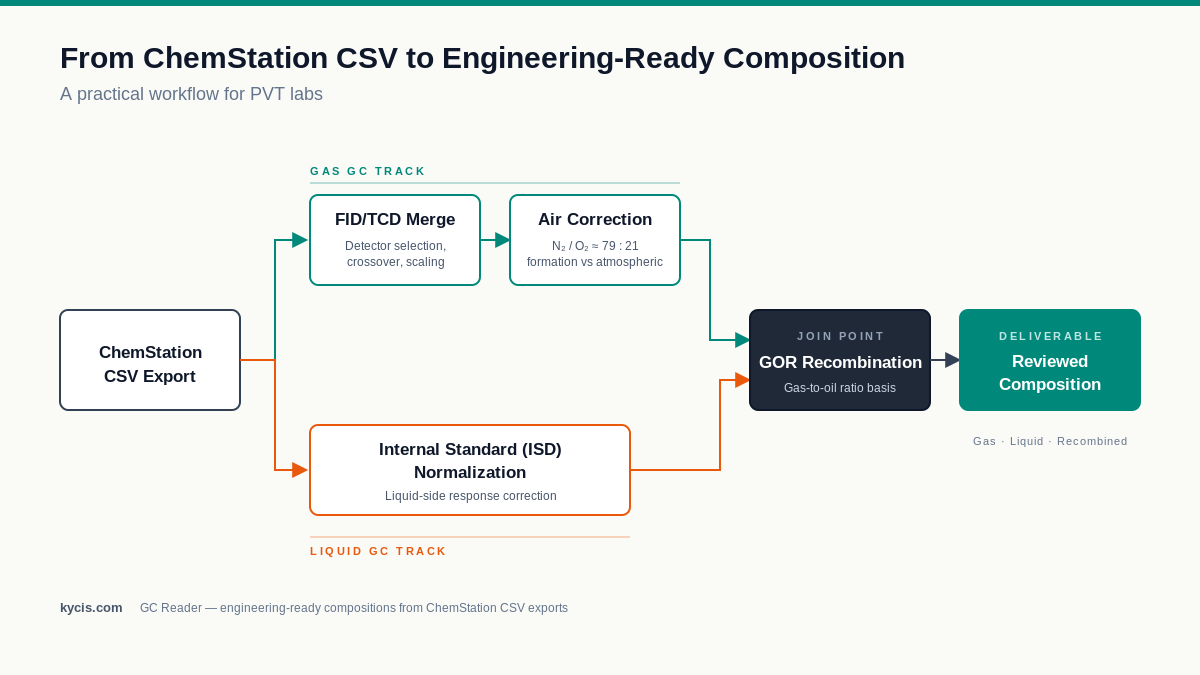
The value is not simply opening a CSV. The value is turning instrument output into a repeatable, traceable, reviewable workflow that produces gas, liquid, and recombined compositions consistently across samples and projects.
Why the CSV Export Is Only the Starting Point
ChemStation is designed to control the chromatography system and report analytical results. It is not designed to be the final data-processing system for PVT lab deliverables. Depending on the method and report template, FID and TCD results may appear in separate sections, combined tables, or exported files that need to be interpreted before calculation begins.
The export may also contain component names that do not match the lab reporting library, a downstream simulator, or a client template. Liquid GC and gas GC often require different calculations before they can be combined. Some dry-gas workflows may stop with the gas composition, while separator-fluid workflows usually need gas and liquid tracks to be recombined later.
If the export step itself is still a source of confusion, start with how to export Agilent ChemStation data for PVT lab use. Once the CSV exists, the next question is whether the processing workflow preserves the analytical decisions behind the final numbers.
Step 1: Confirm the Export Structure and Sample Identity
The first review step is basic but important: confirm what the file actually contains. A usable workflow needs to identify the sample name, run identifier, run date, detector sections, component rows, area or amount fields, unit basis, and any report-template variation that changes where the data appears.
This matters even more when exports contain several samples or repeated runs. A PVT sampling program may include multiple separator stages, duplicate runs, or related gas and liquid samples from the same well test. The processing workflow must preserve sample identifiers so every final composition remains traceable to the correct separator condition, sample point, and run.
When this identity chain is weak, the calculations may still look clean, but the deliverable becomes hard to defend. A composition is only useful if the lab can show which sample produced it.
A practical system should also make it obvious when required identity fields are missing. That warning is often more useful than letting an analyst finish a calculation that cannot be tied back to a defensible sample record.
Step 2: Map Component Names Before Calculating
Component naming is one of the most common places where GC workflows become fragile. The chromatography may be correct, but the imported name may not match the name used in the lab’s calculation library or report template. A method might export iC4, i-C4, Iso-Butane, or Isobutane. Another lab may use nC10, n-Decane, or nDecane. Acid gas names can vary too: H2S and Hydrogen Sulfide may refer to the same component but arrive as different labels.
The right behavior is not to guess silently. Unknown names should be flagged, reviewed, and mapped through an alias library so the same import can be repeated consistently later. Aliases are not a marketing feature; they are a control layer that prevents components from being dropped or misclassified because of spelling, shorthand, or lab-specific naming.
Heavy ends need the same clarity. Many reports include a lumped C7+, C10+, or C12+ entry with an assumed molecular weight and specific gravity. How that lump is characterized is a downstream PVT decision. The GC processing workflow still needs to preserve the heavy-end entry clearly and consistently before any downstream characterization can be trusted.
Step 3: Process the Gas GC Track: FID/TCD Merge
From this point, gas GC and liquid GC are often handled as parallel tracks. A dry-gas-only workflow may stop with the gas composition. A separator-fluid workflow usually processes gas and liquid results separately before recombining them by gas-to-oil ratio later.
For gas GC, the major processing step is often the FID/TCD merge. The thermal conductivity detector and flame ionization detector cover different parts of the composition depending on method setup. Permanent gases and light components may come from one detector, while hydrocarbon response comes from another. Turning those two detector outputs into one gas composition requires detector selection logic, crossover rules, scaling or cross-calibration, and normalization.
This is where spreadsheets become risky. Sorting rows, copying detector values, choosing crossover components, and pasting formulas may work for one sample, then fail quietly when the next export has a different component order or missing row. The goal is a reviewed gas composition built from explicit merge rules, not a one-off spreadsheet result. See FID/TCD merge in gas chromatography for a deeper discussion of why this step matters.
Step 4: Correct Air Contamination When Needed
Air contamination is a gas-side correction that should be visible and traceable. A common screening clue is a nitrogen-to-oxygen ratio close to atmospheric air, about 79:21, or 3.76:1. If the oxygen and nitrogen pattern indicates contamination, the workflow may need to correct the reported nitrogen and renormalize the remaining composition.
The correction should not behave like a black box. The analyst still needs to distinguish formation nitrogen from atmospheric contamination, and the final composition should preserve whether a correction was applied. For more detail on the chemistry and edge cases, see air correction in GC analysis.
Step 5: Process the Liquid GC Track: Internal Standard (ISD) Normalization
This step applies to workflows that include liquid GC. It is not the next serial step after air correction for dry-gas-only samples. It is the parallel liquid-side track that later joins the gas-side result during recombination.
Liquid GC often uses an internal standard to correct response and improve repeatability. That means the workflow needs to preserve the internal-standard parameters, apply normalization consistently, and keep the resulting liquid composition separate from the gas composition until the correct recombination step. The output is a reviewed liquid composition, not a final wellstream composition by itself.
For the calculation details, see ISD normalization in gas chromatography.
Step 6: Recombine Gas and Liquid Results Using Gas-to-Oil Ratio (GOR)
Separator gas and liquid compositions are separate analytical outputs until they are recombined. In a separator-fluid workflow, the gas composition tells one side of the sample story, and the liquid composition tells the other. The gas-to-oil ratio provides the basis for combining them into a representative wellstream composition.
This step depends on correct sample pairing. The gas and liquid results must belong to the same sampling condition, separator stage, or project context. If sample identity was lost during export handling, recombination can produce a clean-looking number that represents the wrong physical fluid.
The recombination basis also needs to be explicit. The workflow should record the GOR value used, the basis of the gas and liquid compositions, and whether the recombined result represents a separator condition, stock-tank condition, or project-specific reporting basis. Those details are easy to lose when recombination is done manually, but they are essential when another engineer later asks how the final wellstream composition was produced.
GOR recombination is therefore not just another normalization step. It is where the two parallel tracks join. The output is a recombined wellstream composition, ready to be formatted and reviewed before delivery.
Step 7: Format, Review, and Deliver the Composition
After recombination, the remaining work is not another composition calculation. It is the controlled delivery of the result. The final composition needs resolved component names, a consistent component order, clear units and basis, reasonable significant figures, and the expected gas, liquid, or recombined output format.
Flags and review notes matter here. If air correction was applied, that should be visible. If an alias was added, the mapping should be recoverable. If internal-standard normalization or GOR recombination used project-specific parameters, those decisions should remain part of the record.
Every downstream PVT calculation inherits the assumptions and errors in the composition it receives. EOS tuning, heavy-end characterization, dew-point calculations, and reservoir-fluid reporting all depend first on a reviewed GC composition with traceable component mapping, corrections, and recombination settings. Downstream PVT work may be complex, but the first requirement is still a clean composition.
This is why composition processing deserves its own workflow instead of being treated as clerical cleanup after chromatography. A small naming error, an unreviewed air correction, or a mismatched gas/liquid pair can propagate into later engineering work. The later calculation may be sophisticated, but it cannot repair uncertainty that was introduced at the composition-preparation stage.
Auditability Matters as Much as Automation
For a PVT lab manager or reservoir-fluid consultant, automation is not valuable if it creates an unreviewable black box. The goal is to make the repeatable parts consistent while keeping the review points visible: what file was imported, which aliases were applied, whether air correction was used, which internal-standard parameters were applied, and which GOR was used for recombination.
That audit trail is what turns a calculation into a defensible deliverable. It also makes repeated work faster. Once the lab has reviewed the alias rules, merge logic, and reporting format for a project, the next sample can follow the same controlled path instead of rebuilding the workflow in a spreadsheet.
Where GC Reader Fits
If this workflow happens once, a careful spreadsheet may be enough. If it happens every week across many samples, projects, and report formats, the workflow needs to be controlled.
GC Reader is built around that practical workflow. It reads ChemStation CSV exports, flags unknown component names for alias review, applies FID/TCD merge logic for gas GC, supports air correction, handles liquid GC internal-standard normalization, and recombines gas and liquid results by GOR when the workflow requires it.
The point is not to replace chromatographer review. The point is to remove fragile copy-paste steps, keep the review decisions visible, and produce compositions that can be used consistently in reports, client deliverables, and downstream engineering work.
GC Reader workflow
Have a recurring ChemStation-to-composition workflow?
Send us a representative ChemStation export and we can review whether GC Reader can parse the structure, identify detector sections, resolve component names, and produce the gas, liquid, or recombined composition workflow your lab needs. Labs that want hands-on evaluation can also request a 14-day trial.