
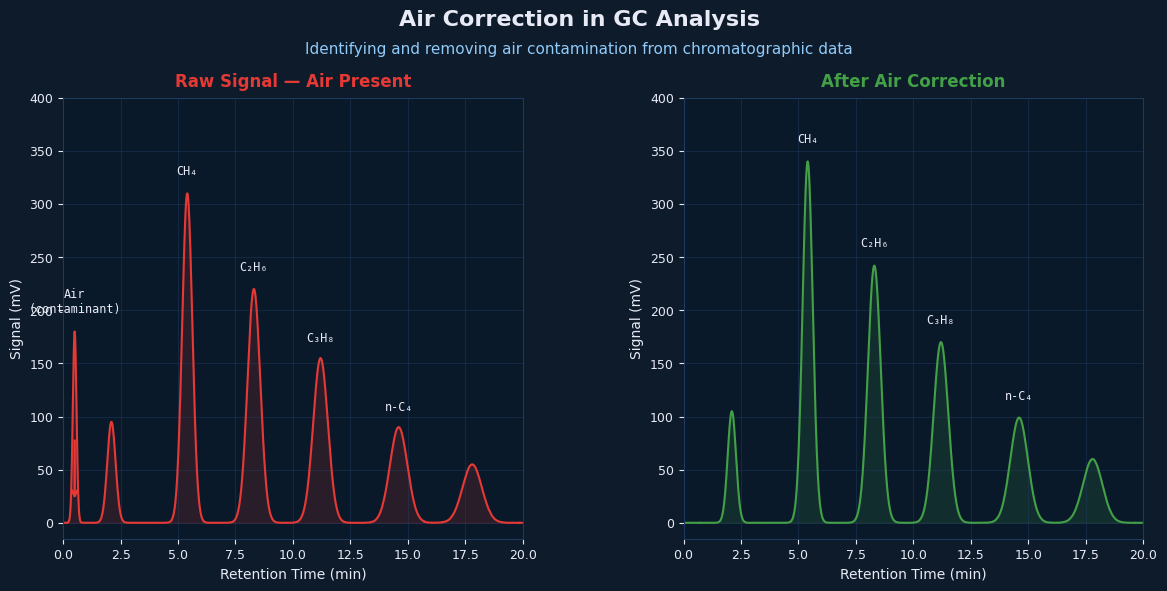
When reservoir fluid samples are collected and analyzed by gas chromatography, one of the most common sources of error is atmospheric air contamination. Nitrogen and oxygen from the atmosphere can enter the sample at virtually any stage—from sampling to transport to lab injection. This post explains how air contamination affects GC results and how the TCD channel is used to detect and correct for it.
Why Air Gets Into GC Samples
Reservoir fluid samples are collected under high pressure, but handling and transfer operations often create opportunities for air ingress. Evacuation steps, valve leaks, and sample container headspace can all introduce atmospheric gases. Even a small air contamination of 0.1–0.5 mol% can significantly distort the reported N₂ content.
How the TCD Sees Air
The Thermal Conductivity Detector (TCD) in a GC is particularly sensitive to permanent gases like N₂, O₂, H₂, CO₂, and H₂O. Unlike the FID, which only responds to hydrocarbons, the TCD sees all components in the light gas channel. This makes it the primary detector for detecting atmospheric contamination, since it will clearly show both N₂ and O₂ peaks—and the N₂/O₂ ratio is the diagnostic tool for identifying air contamination.
Atmospheric air has a fixed N₂/O₂ ratio of approximately 3.76:1 by mole. If the measured N₂/O₂ ratio in a sample closely matches this, the nitrogen is likely from air, not from the reservoir. If the ratio is much higher (e.g., 20:1 or 50:1), the nitrogen is likely formation-derived.
Identifying Contamination vs. Formation Nitrogen
The most reliable diagnostic is the N₂/O₂ ratio. Formation nitrogen typically shows no associated O₂ peak, or an O₂ concentration well below the 3.76:1 air ratio. Use these guidelines:
- N₂/O₂ ratio ≈ 3.76: Air contamination is the primary nitrogen source
- N₂/O₂ ratio > 10: Mixed contamination and formation nitrogen possible
- O₂ not detected, N₂ > 0: Likely formation nitrogen
The Correction Calculation
Once air contamination is confirmed, the correction procedure is as follows: calculate the moles of air-related N₂ from the detected O₂ (multiply O₂ mol% by 3.76), subtract this from the total reported N₂, and renormalize the composition to 100 mol%. This yields the corrected reservoir fluid composition with air nitrogen removed.
The corrected N₂ = Total N₂ − (O₂ × 3.76). All components are then renormalized by dividing by (1 − air_fraction) × 100.
What Happens When You Skip This Step
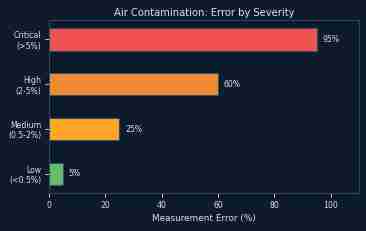
Uncorrected air contamination inflates the N₂ content and deflates all hydrocarbon components proportionally. A sample with 2% air contamination will report approximately 2% lower methane content, 2% lower C2+, and 2% lower total hydrocarbon. For PVT calculations—especially dew point pressure, saturation pressure, and GOR—this can lead to significant engineering errors.
Recognizing Edge Cases
There are several edge cases where the N₂/O₂ ratio diagnostic may be misleading. If O₂ has been consumed by oxidation reactions in the sample cylinder, the O₂ peak may be absent even though air contamination occurred. In this case, the analyst must rely on comparison with other sample splits or historical data for the same well.
Additionally, some reservoir fluids contain trace O₂ from formation water or microbial activity. If O₂ is detected but N₂ is zero or very low, this may not be air contamination. Always evaluate the complete gas chromatogram context.
Automating the Correction
GC Reader software from KYCIS automates the air correction step. After importing ChemStation data, GC Reader checks the N₂/O₂ ratio, applies the air correction formula when contamination is detected, and outputs the corrected molar composition with a correction flag for traceability. This eliminates manual calculation errors and ensures consistent treatment across all samples in a project.
Related GC Reader workflow: Air correction usually sits after ChemStation export and FID/TCD detector merge, before final normalization and report-ready composition output. See GC Reader for a controlled workflow that keeps these steps traceable across recurring PVT lab samples.