
A recombined wellstream composition is not created by placing a gas table beside a liquid table. The result depends on accepted GC compositions, compatible component identities, the project gas-oil ratio (GOR), and the oil-density basis. A small input or mapping error can affect every downstream mole fraction even when both chromatograms were accepted correctly.
This checklist is for PVT laboratories reviewing the step between separate gas and liquid GC results and an engineering-ready wellstream composition. GC Reader performs this downstream calculation and prepares an XLSX report, while the laboratory remains responsible for accepting the analytical results and approving the project basis.
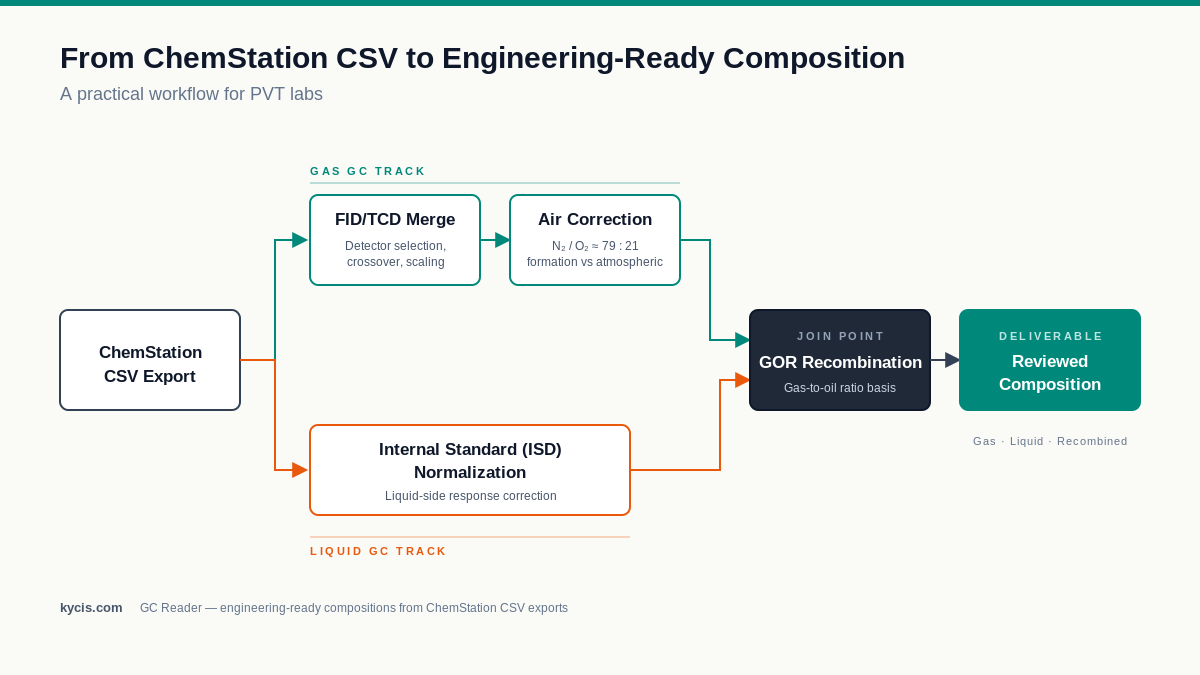
Recombination is a material-balance calculation
The gas and liquid streams contribute different numbers of moles to the recombined result. GC Reader uses the processed gas and liquid mol% compositions together with GOR and oil density to calculate their relative contributions, merge components on controlled names, and normalize the combined wellstream composition.
For each component, the recombined mole fraction is its mole-weighted contribution from the gas and liquid streams. Determine the relative mole contributions before combining the component tables.
This distinction matters because a visually reasonable table can still have the wrong basis. Copying two normalized compositions into a workbook and applying an undocumented weighting factor does not show whether the correct project GOR, density, or source results were used.
Minimum review package
Before recombination, retain the accepted gas result, accepted liquid result, approved recombination GOR and basis, reviewed oil density, component-name mapping, and the requested reporting/lumping basis. If one item is unresolved, the final wellstream composition should remain under review.
Eight review gates before exporting the result
- Match the reporting scope. Confirm that the gas and liquid results belong to the same intended sample and to the correct flash or separator stage defined by the project.
- Accept both analytical results first. Calibration, integration, detector decisions, and chromatographic QA remain in the CDS and laboratory procedure. For accepted Chromperfect liquid exports, see the ZED-to-liquid-GC report workflow before reviewing the combined-stream basis.
- Review each processed composition. Check gas detector consolidation and any air correction, then check the liquid normalization or internal-standard result before combining the streams.
- Resolve component identities. Map approved aliases to standard component names and clear missing molecular-weight data before recombination.
- Confirm the GOR basis. Use the recombination GOR approved for this sample and reporting condition, with its units, gas reference temperature and pressure, and liquid-volume basis clearly identified. Do not reuse a convenient value from a different separator stage, flash condition, or worksheet.
- Review oil density. Confirm the measured or approved density, its units, and its reference temperature and pressure. The density must represent the liquid on the volume basis used for the recombination GOR. If density is calculated from the liquid composition and component library, review the component-property basis and calculated value before accepting the result.
- Inspect the full-resolution result. Check the gas/liquid contribution, component totals, wt% and mol% outputs, and any warnings before display lumping is applied.
- Select the report depth deliberately. Export the summary needed by the client and retain the processing detail required for internal technical review.
Check the calculation basis before entering values
The current GC Reader calculation uses GOR in m3/m3, oil density in kg/m3, and a fixed gas molar volume of 23.6446 L/mol at 15°C and 101.325 kPa. Do not enter a GOR in scf/STB directly or assume the tool identifies different reference conditions automatically. Reconcile units, gas reference conditions, and the corresponding liquid-volume/density basis using an approved laboratory procedure before calculation. If that basis is unresolved, keep the result under review.
Do not let alias gaps become material-balance errors
Gas and liquid methods may report the same species with different names. A primary component name, laboratory abbreviation, and CDS label can all refer to one chemical identity. Recombination should merge those rows only after they resolve through an approved component library.
GC Reader checks primary names and defined aliases. If a name cannot be resolved or lacks required molecular-weight data, the analyst should correct the controlled mapping and reprocess the source result. Silently treating two labels as different components can split one species across the final table; silently treating different species as equivalent creates the opposite error.
Preserve full resolution before applying lumping
Lumping is a reporting choice, not a replacement for the base calculation. A client may request a C7+, C10+, or another grouped output, while an internal reviewer may need the individual components used to produce it.
GC Reader retains the full-resolution recombination result and applies the selected lumping to the displayed/reporting view. This allows the laboratory to review the underlying composition and then produce the grouping required by the project without rebuilding the recombination in another workbook.
What the XLSX report should let a reviewer verify
| Review question | Evidence retained in the report workflow |
|---|---|
| Which result is being delivered? | Final stream type, report status, and the recombined wt% and mol% composition. |
| What project basis was used? | GOR, oil density, selected lumping, and recombination information. |
| Can the result be traced to its sources? | Gas and liquid source identifiers plus metadata appropriate to the selected report depth. |
| Were names and properties resolved? | Warnings, component properties, alias-related processing information, and optional Cn+ property tables. |
| Is more detail needed for internal QA? | Optional gas, liquid, processed-input, raw-data, and detailed processing sheets. |
The minimum GC Reader export includes the Summary, Recombined Composition, and Metadata sheets. Additional report options can retain gas and liquid compositions, Cn+ properties, processed inputs, and detailed source information when the reviewer needs more than a client-facing summary.
When not to produce a recombined composition
Do not recombine simply because gas and liquid results are available. A standalone gas composition, liquid composition, or stage-specific report may be the requested deliverable. Recombination is appropriate only when the project defines the streams and basis needed to represent a wellstream or other combined fluid.
Likewise, do not proceed when GOR, density, sample pairing, component mapping, or the accepted source result is uncertain. Automation should make an incomplete basis visible rather than make it easier to issue an unsupported number.
Run a representative acceptance test
Before standardizing a production workflow, test one representative project that includes the actual gas detector exports, liquid export, component aliases, GOR and density basis, expected lumping, and required report sheets. Compare the result with an independently reviewed laboratory calculation and document any accepted differences.
To evaluate the workflow, request a GC Reader sample-file review and describe the required report basis. Do not send confidential client data; KYCIS will provide file-transfer instructions after reviewing the request. A redacted representative structure is enough to determine whether the current inputs, mappings, recombination controls, and XLSX output fit the laboratory’s review process.