

Many apparent disagreements between PVT calculations begin with units. Pressure must describe the same absolute state, temperature must use the required scale, and molecular weight must match the calculation basis. These checks should precede any comparison of EOS results.
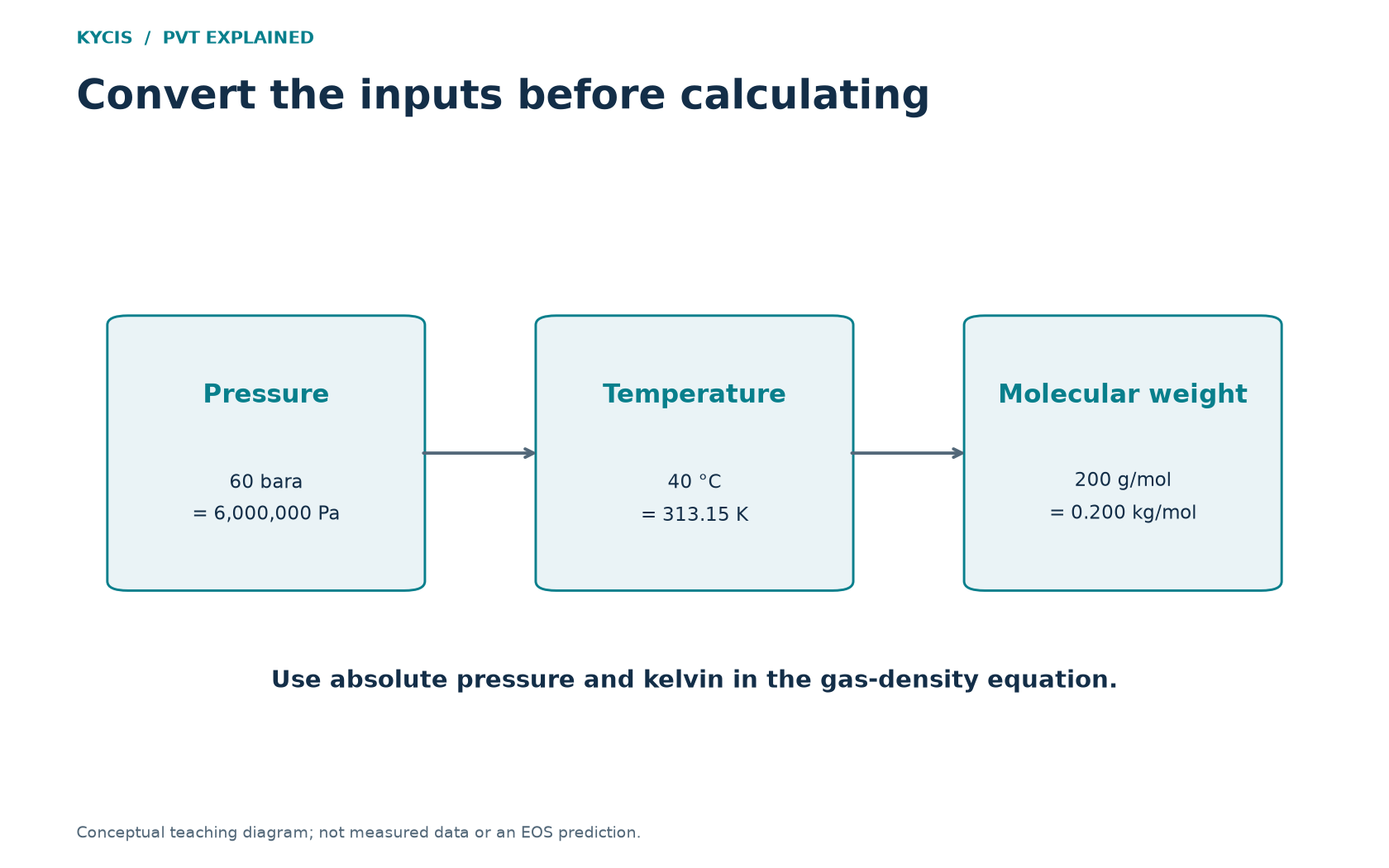
The safest input record contains the original value, its original unit and the converted value used for calculation. A bare number copied from a spreadsheet is not enough.
Convert pressure and identify its reference
One bar equals 100,000 Pa, and one MPa equals 1,000,000 Pa or 10 bar. Consequently, 60 bar absolute equals 6 MPa absolute or 6,000,000 Pa.
Gauge pressure is measured relative to a reference atmospheric pressure. Convert it using P_absolute = P_gauge + P_atmospheric. For an arithmetic illustration, 60 bar gauge plus an assumed atmospheric pressure of 1.01325 bar gives 61.01325 bar absolute. Use the applicable reference for the source measurement instead of treating that illustrative atmosphere as a universal site value.
Writing bar without the reference may leave an important ambiguity. Preserve bara or barg where those labels are used by the source. A calculator expecting absolute pressure cannot infer that distinction from the numeric value.
Use an absolute temperature in thermodynamic equations
Convert Celsius to kelvin with T_K = T_C + 273.15. A temperature of 40°C is 313.15 K. For Fahrenheit, use T_K = (T_F-32)*5/9 + 273.15.
A temperature difference of one kelvin has the same size as a difference of one Celsius degree, but the absolute readings have different zero points. This distinction matters when entering temperature into equations containing T in a denominator or an EOS temperature function.
Negative Celsius temperatures are not inherently invalid. The important issue is whether the converted absolute temperature and the intended thermodynamic model are appropriate.
Distinguish equivalent molecular-weight units
The numerical value in g/mol equals the numerical value in kg/kmol. A molecular weight of 200 g/mol is therefore 200 kg/kmol, but it is 0.200 kg/mol.
| Reported value | Equivalent value |
|---|---|
| 60 bar absolute | 6,000,000 Pa absolute |
| 40°C | 313.15 K |
| 200 g/mol | 0.200 kg/mol |
| 200 g/mol | 200 kg/kmol |
| 0.05 mole fraction | 5 mol% |
The last row is a scale conversion, not a conversion between mass and mole composition. Mass-to-mole conversion additionally requires component molecular weights.
Keep reference conditions separate from flash conditions
A reported standard gas volume uses declared reference conditions. The conditions at which a sample is flashed may be entirely different. Record each set separately and avoid treating standard conditions as a universal temperature and pressure convention across all reports.
Likewise, density reference temperature and specific-gravity convention belong with the reported heavy fraction data. A unit conversion cannot repair a missing reference condition.
Perform a round-trip check
Take one pressure, one temperature and one molecular weight from the input. Convert them into the calculator's units, then back into the original units. The recovered values should agree within chosen rounding. A factor of 1,000 or an offset of 273.15 usually points directly to a unit or scale error.
Changing display units should preserve the physical state. After a display-unit switch, compare the converted values rather than interpreting the changed numerals as a different calculation case.
For the broader experimental context, see what laboratory PVT analysis measures. Contact KYCIS to discuss a PVT calculation question.
Convert a gas volume without changing its material basis
For the same amount and composition of a single gas phase at two specified states, V2/V1 = (Z2/Z1)(T2/T1)(P1/P2). Temperatures and pressures must be absolute. An illustrative change from 15°C to 20°C at unchanged pressure and unchanged Z gives V2/V1 = 293.15/288.15 = 1.01735. That is a 1.74% volume difference with no extra gas produced. These reference temperatures are an example, not a universal standard.
If cooling or depressurization changes the phase split, the same-gas shortcut is no longer sufficient: identify the separated gas amount and composition first, then evaluate that gas at the reporting conditions. A whole-feed volume and a separated-gas standard volume have different material boundaries.
For a PvtLabOnline PT study, keep a row for the operating state and separately record the reporting reference. Its display-unit controls help compare Metric and Field results, but changing the unit selector is not a physical expansion or cooling calculation. A unit round trip should leave the selected state and phase result unchanged.