

To convert mole fractions to mass fractions, multiply each component's mole fraction by its molecular weight, then divide by the mixture molecular weight. The conversion matters because a small mole fraction of heavy material can represent a substantial share of the mass.
The equations are M_mix = sum(z_i*M_i) and w_i = z_i*M_i/M_mix. Here z is mole fraction, w is mass fraction and M is molecular weight. Use a consistent molecular-weight unit for every component. The unit cancels in the fraction calculation.
A complete three-component example
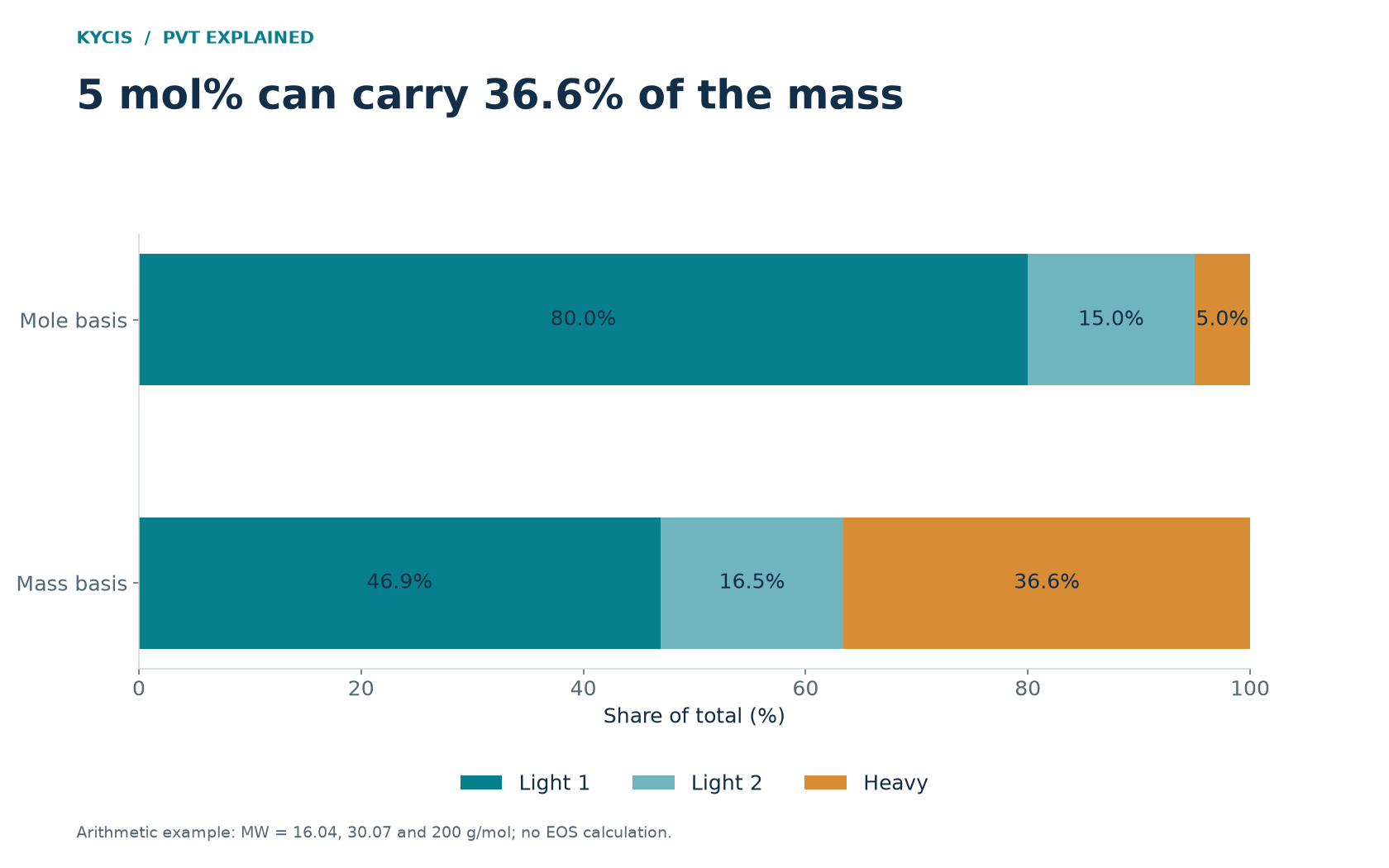
Take a synthetic mixture containing 80 mol% methane, 15 mol% ethane and 5 mol% of a fictional heavy pseudocomponent. Use molecular weights of 16.04, 30.07 and 200.00 g/mol respectively. These rounded values define the arithmetic example; the heavy fraction is not a measured sample.
On a 100 mol basis, the component masses are 1,283.20 g, 451.05 g and 1,000.00 g. The total mass is 2,734.25 g, so the mixture molecular weight is 27.3425 g/mol.
| Component | Mole percent | Molecular weight g/mol | Mass percent |
|---|---|---|---|
| Methane | 80.000 | 16.04 | 46.9306 |
| Ethane | 15.000 | 30.07 | 16.4963 |
| Heavy pseudocomponent | 5.000 | 200.00 | 36.5731 |
The heavy fraction is only 5% of the moles but approximately 36.6% of the mass. Entering the mass column as mole percentages would describe a substantially different fluid, even though the numbers still sum to 100.
Convert back to mole fractions
For a mass-based composition, divide each mass fraction by its component molecular weight. Normalize those values using z_i = (w_i/M_i)/sum(w_j/M_j).
This reverse calculation should recover the original mole fractions within rounding. It is a useful independent check when a laboratory report contains both bases. If the two tables disagree, first compare component identities, molecular weights and the treatment of the plus fraction. Do not immediately force one table to match the other by changing the reported composition.
Why the heavy fraction molecular weight matters
Keep the example's mole composition fixed but change the assumed heavy molecular weight from 200 to 180 g/mol. The heavy contribution becomes 900 g on the same 100 mol basis, and its mass fraction becomes about 34.17%. The mole percentage remains 5%.
This is a basis-conversion sensitivity, not a phase-equilibrium prediction. It shows why a sample-specific plus fraction molecular weight must accompany a reported mass-to-mole conversion. It does not establish how much a dew point will move.
Four checks before entering the composition
- Identify whether the source values are fractions or percentages. A value of 0.05 as a fraction is 5%, not 0.05%.
- Confirm the column is mole-based or mass-based. Normalization cannot discover that information.
- Use molecular weights that correspond to the actual component list, including each pseudocomponent.
- Keep enough digits during conversion and round only the displayed result.
For an ideal gas at the same conditions, volume fraction corresponds to mole fraction. Do not extend that shortcut to liquid composition or to arbitrary real-fluid volume fractions. Composition basis and property reporting basis should always be labeled separately. NIST's REFPROP documentation also distinguishes mixture composition inputs by mass and mole basis.
PvtLabOnline provides completely free browser-based PVT calculations using molar or mass composition inputs. Check the normalized composition on both bases before running characterization, a phase envelope or PT flash. Read the public PVT calculations guide, then open the free calculator. If the composition starts in a GC export, the engineering-ready composition workflow covers the earlier data preparation steps.
Resolve a laboratory mass/mole mismatch
If a report supplies both mole and mass fractions, each positive component independently implies a mixture molecular weight: M_mix,i = z_i M_i / w_i. Use fractions on both sides. These estimates should agree within reporting precision. Disagreement concentrated in the plus-fraction row suggests checking that row’s molecular weight and identity; disagreement across all rows suggests mismatched samples, bases or normalization. This is a diagnostic, not a reason to alter measured numbers until they fit.
For the worked example, the methane row gives approximately 27.3425 g/mol using the rounded mass fraction. The heavy row gives the same result. Also check 1/M_mix = sum(w_i/M_i). A missing molecular weight prevents a defensible conversion even when normalization succeeds.
In PvtLabOnline, enter the declared composition basis, set a sample-specific Cn+ molecular weight when supported, then normalize and inspect both Molar % and Mass %. Changing Cn+ molecular weight changes the conversion; normalize again and record which source value changed. This provides an input check before a phase calculation.