
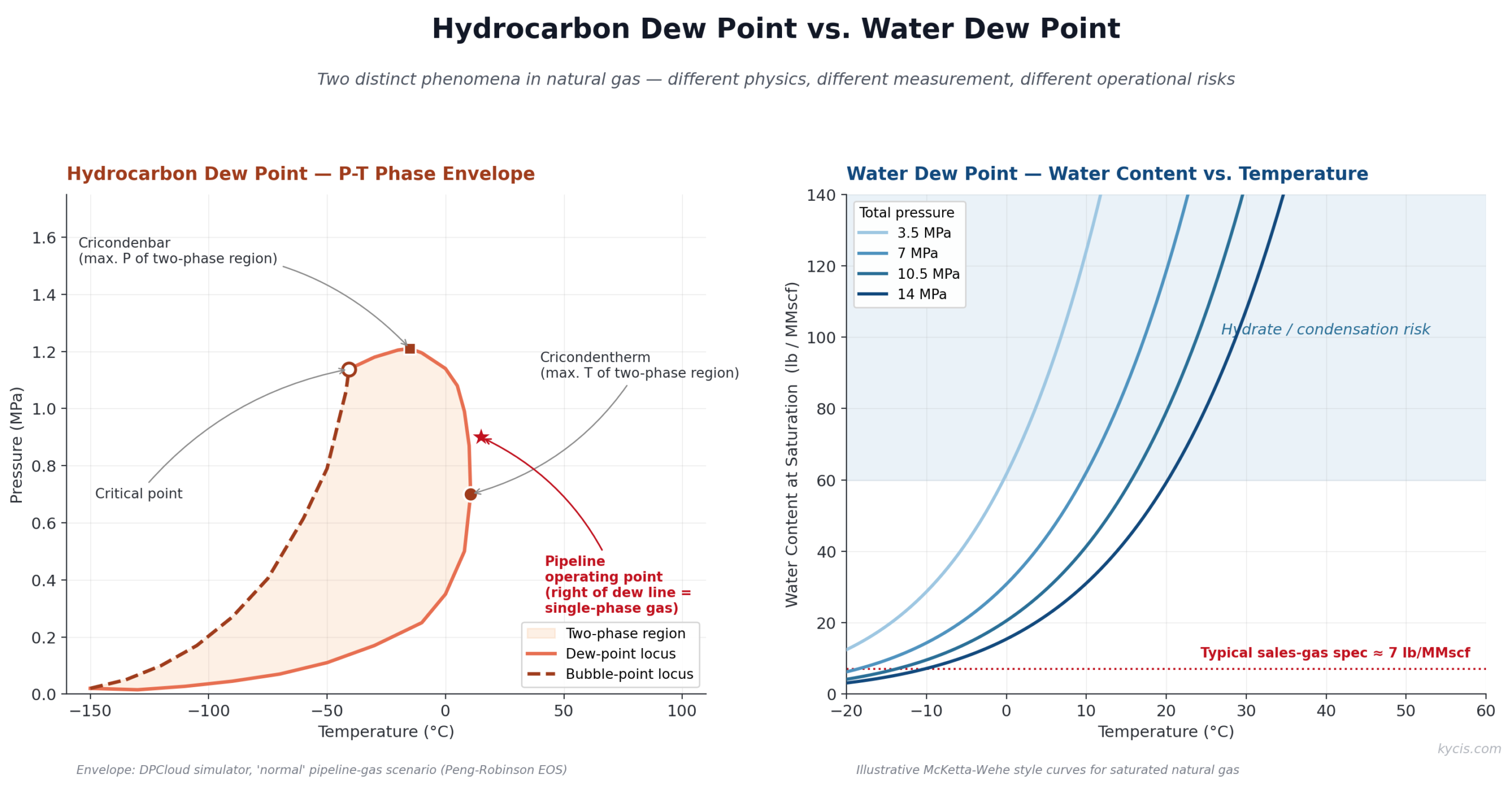
Natural gas quality specifications almost always include dew point requirements — but which dew point? Gas engineers regularly encounter both hydrocarbon dew point (HDP) and water dew point (WDP) in tariff agreements, custody transfer documents, and equipment specifications. While both describe the onset of condensation, they are fundamentally different phenomena with different implications for pipeline operations.
This guide clarifies the distinction between the two, explains how each is calculated or measured, and outlines when each matters most in practice.
The Fundamental Difference
Water dew point (WDP) is the temperature at which water vapor in the gas stream begins to condense into liquid water (or ice, below 0°C). It is governed by the partial pressure of water in the gas and is relatively straightforward thermodynamically — water in natural gas behaves approximately as an ideal component mixed with hydrocarbons.
Hydrocarbon dew point (HDP) is the temperature at which the heavier hydrocarbon components in the gas (typically C5+, C6+, and above) begin to condense out as liquid. This is governed by the complex phase behavior of a multicomponent hydrocarbon mixture and requires a full equation-of-state (EOS) calculation to determine accurately.
The two dew points are thermodynamically independent: a gas can have a high water dew point and a low hydrocarbon dew point, or vice versa. They must be monitored and controlled separately.
Water Dew Point: Causes, Effects, and Measurement
What Causes High Water Dew Point?
Water enters natural gas streams at the wellhead (formation water), during processing (amine scrubbing or other wet processes), through pipe wall corrosion, and from atmospheric moisture ingress during maintenance. Produced gas from reservoirs is almost always saturated with water vapor at reservoir conditions.
Consequences of High Water Dew Point
- Hydrate formation: At high pressure and low temperature, water and light hydrocarbons (C1–C4) form solid crystalline hydrates that can plug pipelines, valves, and instrumentation. Hydrate formation temperatures can be well above 0°C at typical pipeline pressures.
- Corrosion: Liquid water in the presence of CO₂ forms carbonic acid. H₂S and water together form highly corrosive sour condensate. Free water accelerates internal pipeline corrosion dramatically.
- Operational disruptions: Hydrate plugs can take days to remove using methanol or thermal treatment. Pressure spikes from hydrate blockages create integrity risks.
Water Dew Point Measurement and Control
Water dew point is typically measured using chilled mirror hygrometers, electrolytic hygrometers, or capacitance moisture analyzers. These are widely available, well-proven instruments with reasonable maintenance requirements. Glycol dehydration (TEG units) and molecular sieve dryers are the standard process solutions for reducing water content to specification.
Typical pipeline gas quality specifications for water dew point are in the range of −10°C to −20°C at delivery pressure — well below ambient temperatures to provide a safety margin against hydrate formation.
Hydrocarbon Dew Point: Causes, Effects, and Measurement
What Causes High Hydrocarbon Dew Point?
Hydrocarbon dew point is determined by the composition of the gas — specifically, the concentration of heavier components (C5, C6, C7+, BTX aromatics). Rich gas from condensate or retrograde gas condensate reservoirs naturally has a high HDP. Incomplete separation at the wellhead (high GOR, over-pressured separators) and commingling with NGL-rich streams also elevate HDP.
Unlike water dew point, hydrocarbon dew point cannot be easily “removed” — it requires physical separation (slug catchers, condensate scrubbers, NGL extraction) to reduce the heavy component content of the gas stream.
Consequences of High Hydrocarbon Dew Point
- Liquid slugging: Condensed hydrocarbon liquids accumulate at low points and sweep through the system as slugs, causing pressure surges and potential over-pressure events.
- Compressor damage: Liquid ingestion into centrifugal or reciprocating compressors causes blade erosion, seal damage, and potentially catastrophic mechanical failure.
- Meter inaccuracy: Liquid dropout at flow meters causes systematic measurement errors, creating commercial disputes between shippers and pipeline operators.
- Burner performance: Condensed liquids in distribution gas can cause burner flashback, sooting, and uneven combustion.
Hydrocarbon Dew Point Measurement and Calculation
Unlike water dew point, hydrocarbon dew point is significantly harder to measure directly. Chilled mirror HDP analyzers detect the onset of hydrocarbon condensation optically but are expensive (£30,000–£80,000 per unit), require careful sample conditioning, and need regular maintenance and calibration.
The more common approach in modern pipeline SCADA systems is calculation-based HDP monitoring: using the detailed gas composition from an online process gas chromatograph (GC) to compute the dew point via an EOS thermodynamic model. This approach is cost-effective (a single EOS calculation service can serve multiple GC measurement points), provides real-time updates with every GC scan, and gives not just the dew point temperature but the full phase envelope including the cricondentherm (CHDP), cricondenbar, and critical point.
DPCloud provides exactly this capability — a dedicated thermodynamic calculation service that accepts 24-component gas composition inputs from SCADA and returns CHDP, water dew point, and full phase envelope data in under 150ms, at throughputs up to 490 requests per second.
Key Differences at a Glance
| Parameter | Water Dew Point (WDP) | Hydrocarbon Dew Point (HDP / CHDP) |
|---|---|---|
| What condenses | Water (H₂O) | Heavy hydrocarbons (C5+, C6+) |
| Governing thermodynamics | Partial pressure / Henry’s law (simpler) | Multicomponent EOS phase equilibrium (complex) |
| Typical specification | −10°C to −20°C at delivery pressure | 0°C to −5°C (CHDP) |
| Primary risk | Hydrate formation, corrosion | Liquid slugging, compressor damage, meter error |
| Measurement method | Chilled mirror, capacitance sensor | Chilled mirror HDP analyzer OR calculation from GC data |
| Control method | Glycol dehydration, molecular sieve | NGL extraction, condensate scrubbing |
| Real-time SCADA integration | Moisture analyzer → DCS/SCADA; or EOS service (e.g., DPCloud) computing water DP from composition (incl. H₂O) | EOS calculation service (e.g., DPCloud) fed by process GC |
Which Matters More?
Both matter — but for different reasons and in different parts of the gas value chain:
- Upstream / wellhead: Water dew point is the primary concern (formation water, hydrate risk in cold subsea or arctic environments). Hydrocarbon dew point becomes important as gas moves toward separation and export.
- Midstream / transmission: Both are critical. CHDP specifications at interconnect points protect downstream users from liquid contamination. WDP specifications protect pipeline infrastructure from hydrates and corrosion.
- Downstream / distribution and power generation: Hydrocarbon dew point is particularly important. Liquid hydrocarbons in distribution gas or gas turbine fuel can cause serious combustion problems and regulatory non-compliance.
Frequently Asked Questions
Can a single analyzer measure both water and hydrocarbon dew point?
Some chilled mirror instruments are claimed to detect both, but separating the two condensation events reliably is technically challenging. In practice, most facilities use dedicated WDP analyzers for water monitoring and either a dedicated HDP analyzer or a calculation-based approach (process GC + EOS engine) for hydrocarbon dew point. The calculation approach has the advantage of also providing the full phase envelope, not just the dew point temperature at one pressure.
Does water in the gas affect hydrocarbon dew point calculations?
For typical pipeline gas quality calculations, water content is treated separately. The hydrocarbon EOS calculation (PR or SRK) is performed on the dry hydrocarbon composition, with water dew point calculated independently using a water-hydrocarbon interaction model (e.g., Bukacek correlation or GERG-Water). Modern calculation services like DPCloud handle both calculations from a single composition input.
What happens to hydrocarbon dew point when pressure drops?
The hydrocarbon dew point temperature at a given pressure can be higher or lower than at a different pressure — it depends on where you are on the phase envelope relative to the cricondentherm. For gas at high pressure (above the cricondenbar), pressure reduction will eventually bring the gas into the two-phase region. This is a common issue at pressure regulating stations: gas that is dry at high pressure can form liquid as pressure drops across the regulator.
Conclusion
Understanding the distinction between hydrocarbon dew point and water dew point is fundamental to gas quality management in pipeline operations. Both parameters must be monitored continuously and independently — treating one as a proxy for the other is a common mistake with potentially serious operational consequences.
For real-time CHDP monitoring in SCADA environments, calculation-based approaches using an EOS engine fed by process GC data are increasingly the preferred solution — accurate, cost-effective, and scalable across multiple measurement points. Explore DPCloud’s dual dew point calculation capabilities to see how it integrates with your existing SCADA infrastructure.
Related: Dew Point Measurement vs Real-Time Calculation: ISO 18453, Chilled Mirrors, and When to Trust Which — A practical framework for when to trust certified measurement vs real-time calculation in pipeline gas-quality decisions.